Taking the guesswork out of moving assets into Chase.
JPMorgan Chase / Automated account transfer
JPMorgan Chase / Automated account transfer
This isn't a UX flow. It's the front door for capital inflow.
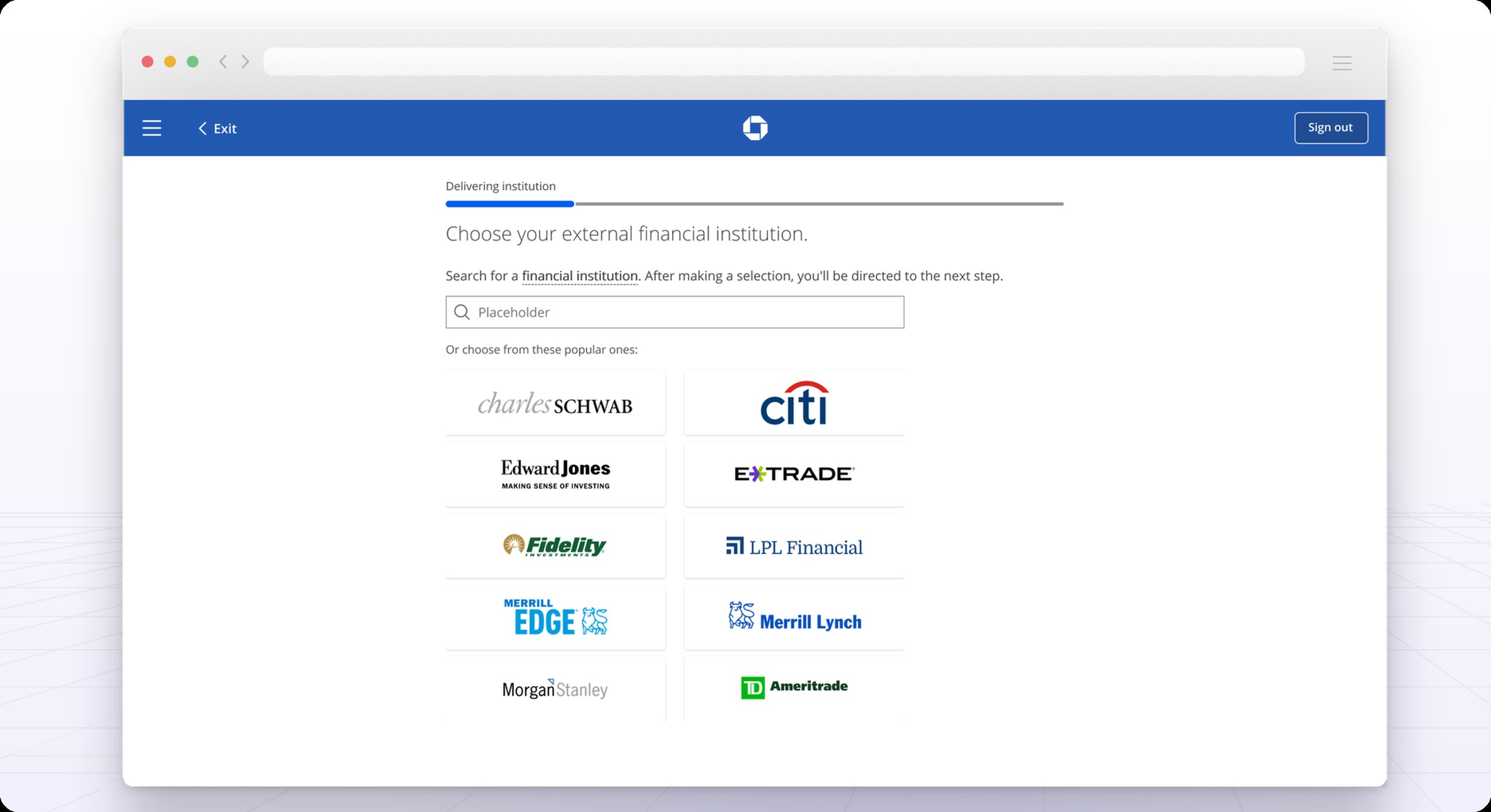
ACAT lets customers move investments from Fidelity, Schwab, and other institutions into Chase without paperwork or branch visits. Every friction point erodes trust and drives support cost.
Imagine transferring money between banks, but you download a PDF, fill it by hand, mail it, then wait with no idea if it worked.
Customers weren't stuck. They were flying blind, so they called for reassurance.
Four core issues surfaced from feedback and service data:
The baseline call driver was clear: the #1 reason customers called was “Where is my transfer?” Vague “pending” states offered limited visibility, and call logs tagged this as the top ACAT reason under Transfer Status.
The real issue wasn't submission. It was uncertainty after submission. “Pending” didn't tell customers what was happening, what to do next, or what to expect.
I chose status transparency and expectation setting first, because it addressed the #1 call driver faster than expanding institution coverage.
I set shared success criteria before building, so design decisions weren't subjective.
Success metrics anchored in a service blueprint
14 opportunities narrowed to 4 action items based on pain, feasibility, and ROI
Transfer tracking: status, wayfinding, recovery
Bi-weekly sprints across product, ops, and tech
I scoped the MVP around one goal: enough status transparency to stop the #1 call driver, not a fully featured tracker.
When backend constraints ruled out real-time status fidelity, I made the call to ship a simplified version: confirmed submission, current stage, expected timeline. The full-vision spec stayed intact as a documented brief for the next phase. The constraint changed the vehicle, not the strategy.
What I owned: the tradeoff definition, the rationale for the simplified tracker presented to Engineering, and continuity between the MVP and the post-launch roadmap.
The ideal status tracker, where customers follow their transfer from submitted to in progress to completed.
A simplified version that cut development effort. Testing showed which parts mattered least to customers, and we left those out.
To ship in six months, I also deprioritized branch-assisted flows and kept FAQ content lightweight. The primary fix was clearer status and expectations, not more documentation.
Beyond the constraints, the updated online experience also removed customer frustrations. One example is ineligible securities, a pain point from release 1.0.
Customers can transfer all positions in an account, or move only some shares with a partial transfer.
The positions page lists every position, with ineligible ones shown before the transfer is submitted.
Finalized designs across the three key steps.
Within three months of launch, call-center volume dropped 15%, and customers could follow their transfer without calling.
In enterprise workflows, the fastest way to reduce service cost is often to eliminate uncertainty, not add features.
When system state isn't legible, customers seek reassurance through support. Designing transparency and expectations into the product reduces calls even when backend constraints remain.
Roku / Audience data management platform