Helping ad teams find the audience data they already had, instead of rebuilding it.
Roku / Audience data management platform
Roku / Audience data management platform
Roku's data management platform is where ad teams find and define the audiences behind every campaign. After a decade, people had given up searching it.
The tool was built about ten years earlier so the ad data team could look up customer attributes and set custom parameters for tracking campaign performance. Over time it became hard to use. When users couldn't find a relevant attribute, they created their own, or kept a separate Excel file instead. The company estimated this cost $3 billion in productivity over nine years.
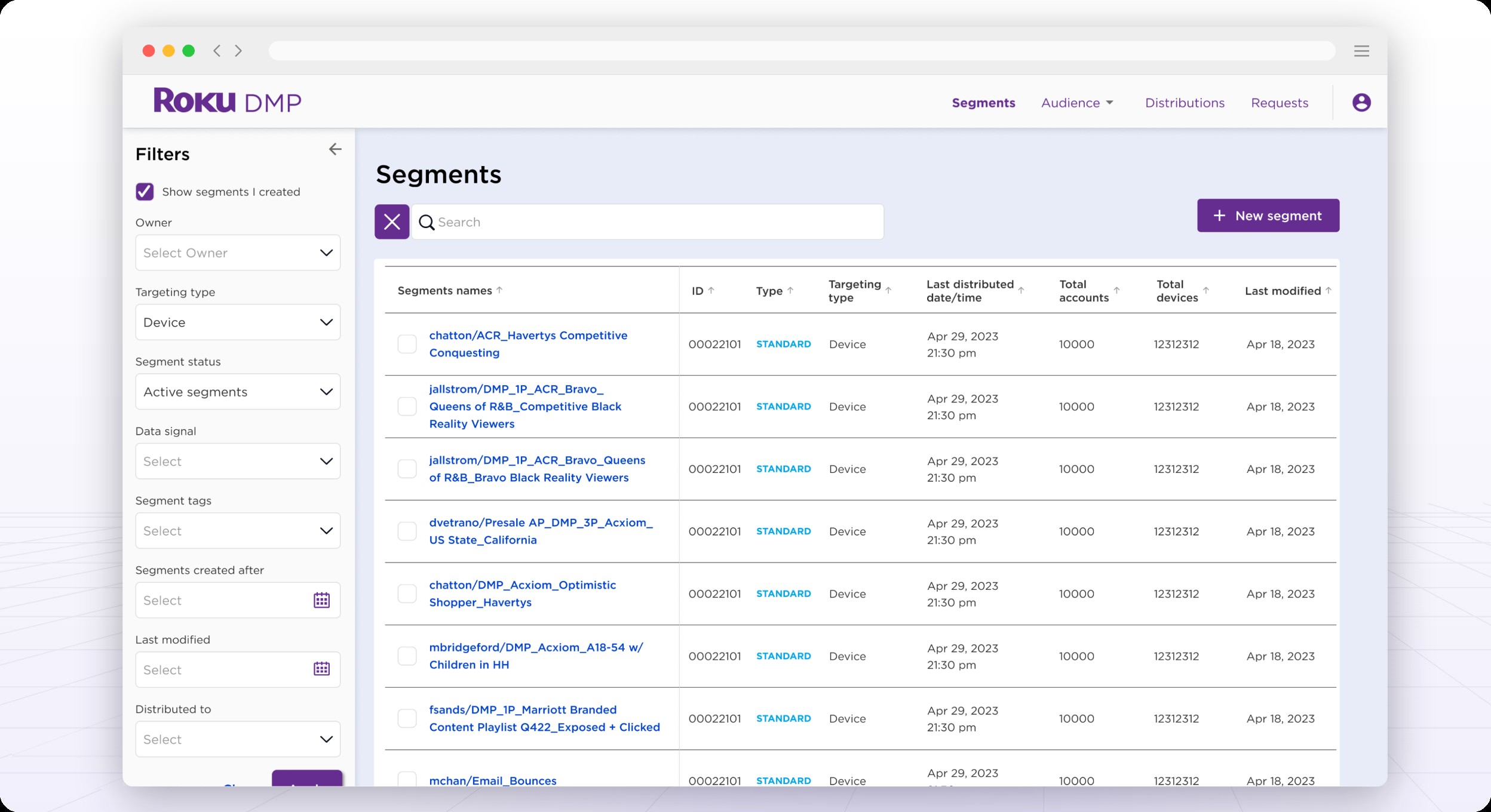
Create a new segment, clone and modify an existing one, or build a segment set
Package segments into a distribution for delivery
Report on audience profile and campaign performance
Users weren't short on data. They couldn't find it, couldn't request it in the tool, and couldn't see where their requests stood.
Product partnered with UX research to define the main problems. Three stood out:
Every failed search became a new duplicate segment, and every request became another thread in someone's inbox.
With limited budget and staffing, I scoped the redesign around the biggest pain points, and a design that could be phased in over time.
We prioritized three things: streamline the existing workflow, design for phased rollout, and adopt the new ad internal tools design language so engineering could build faster. With the other designer, I audited the existing platform and mapped the end-to-end flow for sales and admin users. That map became the benchmark for every later decision.
From the audit and research feedback, the product lead and I set four principles to guide both designers through concepting.
Let users finish a single task without interruption
Users can see what they've made and stay in control
Best practices that raise segment quality and encourage reuse
Bring requests out of Slack and email and into the platform
The columns users already knew, rebuilt around filtering, one clear primary action, and fewer buttons per row.
Two core flows: one for sales and data operations users creating segments, one for admins approving their requests.
Beyond the core flows, I guided the other designer in writing developer onboarding documentation for the core flow, along with specs covering every UI component state.
Two weeks of beta cut duplicate segments by 20%.
I left Roku before the full release. The platform went on to ship to the internal ad data team, built on the flows, principles, and developer documentation we put in place.
“This is a big advancement from the current experience. Kudos to the UX team for putting this together!”
Nafis, Director of Engineering
“New design is clean and will help us with best practices around DMP usage.”
Karan, Director of Product
JPMorgan Chase / Chase notification settings